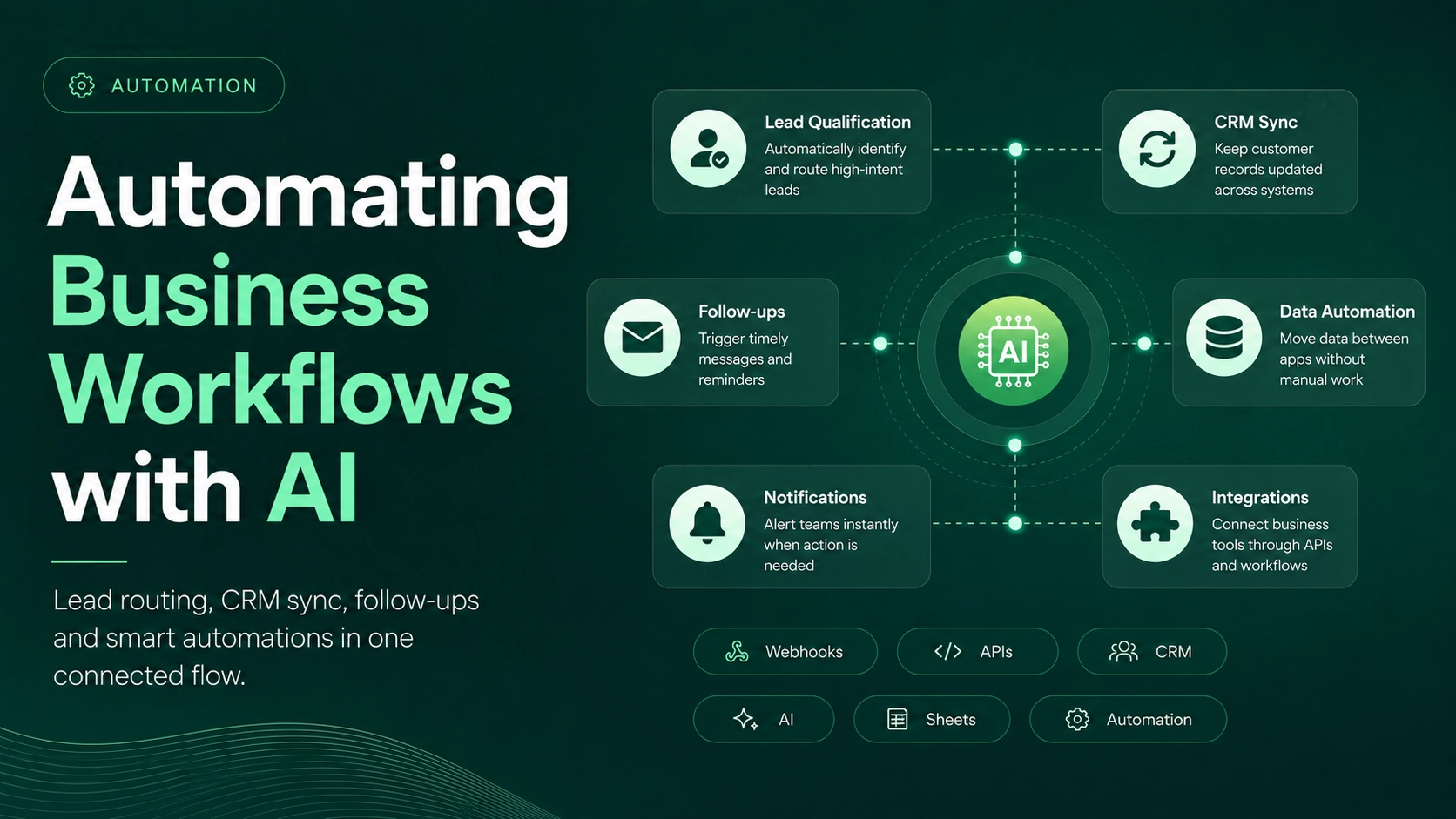
Not every business process needs AI.
Sometimes a simple rule is faster, cheaper and more reliable.
AI becomes useful when the information is messy, conversational or difficult to predict.
That distinction matters.
Automation and AI solve different problems
Traditional automation is great when the rule is obvious.
For example:
Form submitted → Create lead → Assign salesperson → Send confirmation
There is no reason to ask AI what should happen.
Now imagine a customer writes:
"I'm looking for a 2-bedroom apartment in Downtown, around AED 1.5M, preferably ready to move in."
That is where AI becomes useful.
It can turn the message into structured information:
Location: Downtown
Bedrooms: 2
Budget: AED 1.5M
Preference: Ready to move
Then normal automation can continue:
Qualify → CRM → Assign Agent → Follow Up
AI understands the message. Automation handles the process.
Real estate is a good example
Real estate teams receive many enquiries that contain the same information in completely different wording.
AI can understand those enquiries while the workflow handles what happens afterward.
Instead of someone manually reading and organizing every lead, the system can prepare the information before the salesperson even opens the conversation.
E-commerce works differently
An online store already has structured product data.
The challenge is understanding what the customer wants.
Someone might write:
"I need a chocolate birthday cake for tomorrow for around 8 people."
AI can understand the intent.
The store integration can search actual products.
WhatsApp can show the options.
The customer can continue toward checkout.
The AI does not need to invent products. It helps connect natural language with real business data.
AI becomes stronger when connected
A standalone chatbot is useful in some situations, but the bigger opportunity is connecting AI with systems the business already uses.
For example:
Website → AI → CRM
WhatsApp → AI → Product Database
Lead → AI Qualification → Sales Team
Customer Request → AI Intent → Automation Flow
This is why I see AI automation as an integration problem as much as an AI problem.
APIs, webhooks, databases and business rules are what turn an AI response into an actual workflow.
Humans should still be part of the system
Not every decision should be automated.
Sometimes the best workflow is:
AI understands → System prepares → Human decides
This is especially important when the conversation involves money, sensitive information or a complex customer situation.
Automation should remove unnecessary work, not remove people where they are actually valuable.
Start with the bottleneck
When thinking about AI automation, I usually look for questions like:
Where is information being copied manually?
Which enquiries are repeatedly categorized?
Where are leads getting lost?
Which follow-ups are forgotten?
What information needs to move between two systems?
Those questions usually reveal better opportunities than simply asking:
"Where can we add AI?"
The best AI can feel invisible
The customer sends a message.
The system understands it.
The right information is found.
The CRM is updated.
The correct person is notified.
A follow-up happens.
From the customer's perspective, everything simply moved forward.
That is where AI automation becomes genuinely useful.
Not when it looks impressive, but when it quietly removes friction from the way a business works.